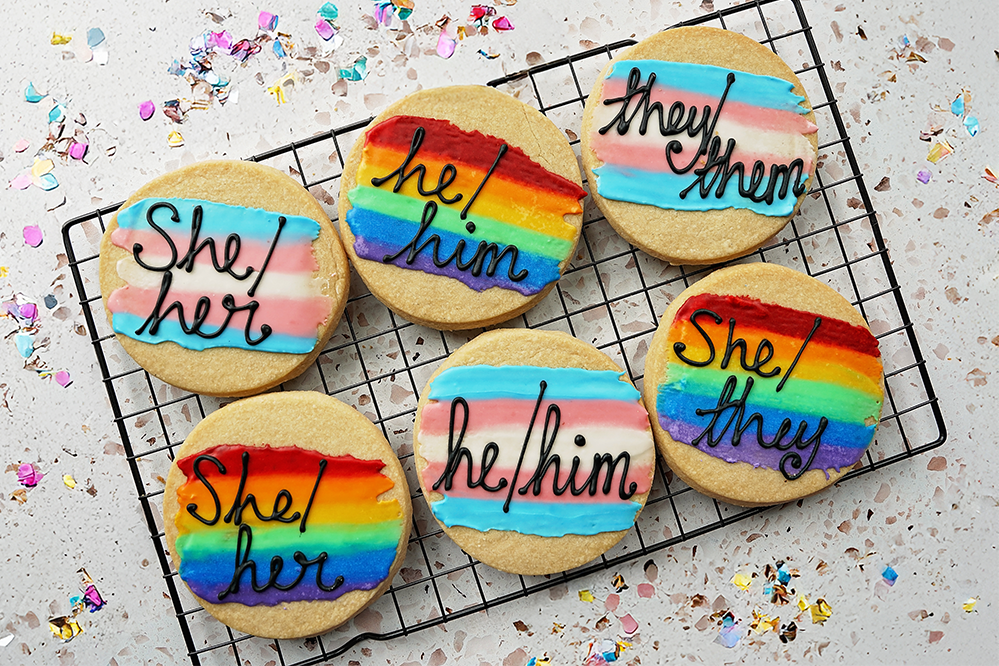
From June 22-28, net proceeds from the sale of our large Brown Sugar Shortbread Cookie will go to Queer Power Alliance, a Seattle nonprofit working year-round across the Puget Sound region.
“Embracing diversity is one of our core values,” says Leslie Mackie, our founder. “We’re proud to celebrate Pride and to stand with an organization doing this work, now more than ever.”
Queer Power Alliance advances LGBTQIA+ liberation through advocacy, education, and community organizing. Their work spans housing justice, economic opportunity, civic engagement, and racial and gender justice. It is rooted in a simple idea: meet people where they are and make sure community members get the support they need.
“Building collective power and showing up for our communities in meaningful, tangible ways is at the heart of what we do,” says Taylor Farley, executive director of Queer Power Alliance. “Partnerships like this make a real difference.”
Our Pride cookie is a sweet way to celebrate and support that work.
Pride Month brings the city together, and the Seattle Pride Parade is its centerpiece. The Northwest’s largest LGBTQIA2S+ parade is community-led, deeply rooted in activism, and draws huge crowds downtown each year, with hundreds of contingents marching for joy, justice, and belonging. This year’s parade is Sunday, June 28, from 11 a.m. to 3:30 p.m., along 4th Avenue from Union Street to Denny Way. The theme is “Rally.”
Our store managers and crew have our support and encouragement to bring their own flair and personalities to each café’s celebrations.
“Working for a bakery like Macrina that supports and highlights our community is such a blessing,” says Joshua Kull, GM of our Mercer Island café.
Make your celebration sweeter with our Pride cookie.
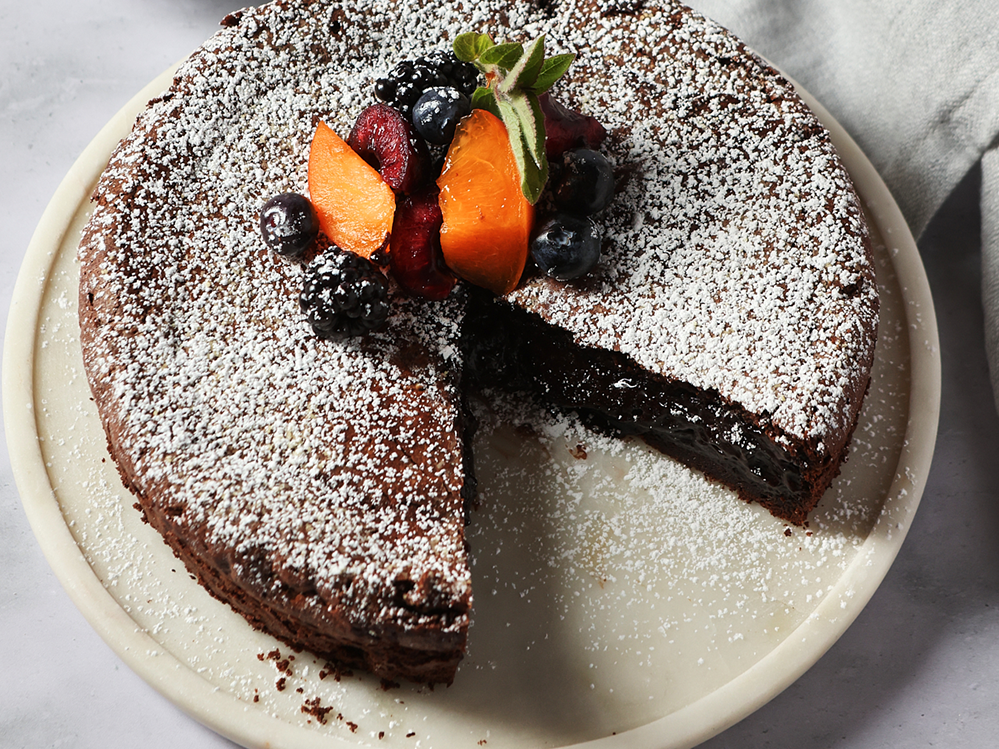
Certain times call for indulgence, at least a sliver of it, and if you’re there right now, like me, you might as well make it exceptional. This chocolate cake is rich, fudge-like and made simply with bittersweet chocolate, espresso, eggs and a scant few tablespoons of flour. Rye flour adds a subtle malty depth, but cake flour or a gluten-free blend works well, too. Serve it still warm, dusted with powdered sugar alongside fresh berries or a scoop of vanilla ice cream.
3 Tbsp rye flour, cake flour or gluten-free flour blend
1 Tbsp powdered sugar, for finishing
Preheat oven to 350°F. Brush a 6-inch round cake pan with neutral oil. Line the bottom with a parchment circle, then fit a 3-inch parchment collar around the inside edge.
Set up a double boiler: fill a medium saucepan with 2 inches of water and bring to a gentle simmer. Set a heatproof stainless-steel bowl on top, making sure the bottom does not touch the water. Add chocolate chips, butter and espresso. Whisk gently until melted and smooth, about 3 minutes. Remove bowl from heat and set aside to cool slightly.
In a stand mixer fitted with the paddle attachment, combine sugar, eggs and vanilla. Beat at medium speed until pale, thickened and ribbony, 3 to 4 minutes.
Reduce mixer to low speed and pour in chocolate mixture in a steady stream. Once incorporated, increase to medium speed and beat until uniformly combined and glossy, 3 to 4 minutes more. Remove bowl from mixer.
In a small bowl, sift together cocoa powder and flour. Dust about one-quarter of the flour mixture over the batter and fold in gently with a spatula. Repeat three more times, folding just until no dry streaks remain.
Scrape batter into prepared cake pan and smooth the top. Bake until surface is set with shallow brownie-like cracks and the center feels firm but gives slightly when pressed, 25 to 28 minutes. A tester will come out with moist crumbs, not wet batter.
Cool in pan on a wire rack for 30 minutes. Run a thin knife or offset spatula around the edge, then invert onto a plate and peel away parchment. Flip upright onto a serving plate, dust with powdered sugar and serve with fresh berries or ice cream.
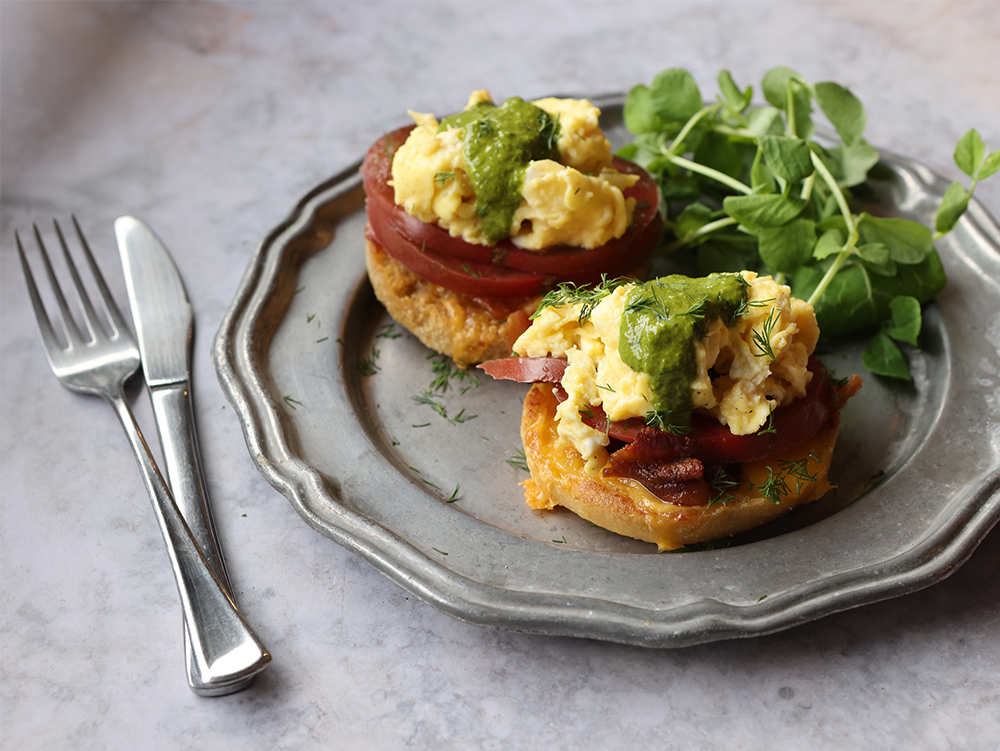
After nearly two years of development, we launched Organic English Muffins this spring. Made with sour white starter and a blend of organic white and whole wheat flours, they inspired this tasty egg sandwich. I’ve always loved tartines, open-faced sandwiches that let each ingredient shine while making a simple meal. Crisp bacon, fresh heirloom tomatoes, lightly scrambled eggs and bright sauce verte pair well with the muffins’ mild tang and chewy bite. Serve with a lightly dressed salad, sliced fruit, or pan-roasted potatoes.
In a blender, combine spinach leaves, dill, tarragon, basil, chives, garlic and lemon juice. With blender running, add olive oil and blend until smooth and bright green. If you prefer it thinner, add a touch more olive oil. Season with salt and pepper. Add a little more lemon juice, if needed, to balance the herbs. Set aside. Sauce verte stays nicely in the refrigerator for up to 1 week.
Preheat oven to 325°F. Line a rimmed baking sheet with parchment paper. Set aside.
In a large cast-iron or nonstick skillet over medium heat, cook bacon, turning every 2 minutes, until bacon is browned and crisp. Remove and place on a paper towel to absorb fat and cool.
Pour off excess rendered fat, leaving a thin layer in the pan. With the pan still over medium heat, sauté 4 muffin halves in the remaining bacon fat, toasting on both sides. Place cut side up on the lined baking sheet and repeat with remaining 4 muffin halves.
Place a slice of cheddar cheese on each half. Place the baking sheet in the oven to melt cheese, 2 to 3 minutes. Remove from oven.
Crumble ½ slice bacon over each muffin half. Top with 2 slices of tomato and a light sprinkle of salt.
Crack eggs into a medium bowl and mix well with a fork to combine. Warm the skillet used earlier over medium heat and melt butter. Add eggs and season with a light sprinkle of salt and pepper. Using a spatula, gently push and fold the eggs, being careful not to overcook them. They should be soft and just set so they stay tender on the tartines.
Top muffin halves with equal amounts of eggs and a dollop of sauce verte. Enjoy!
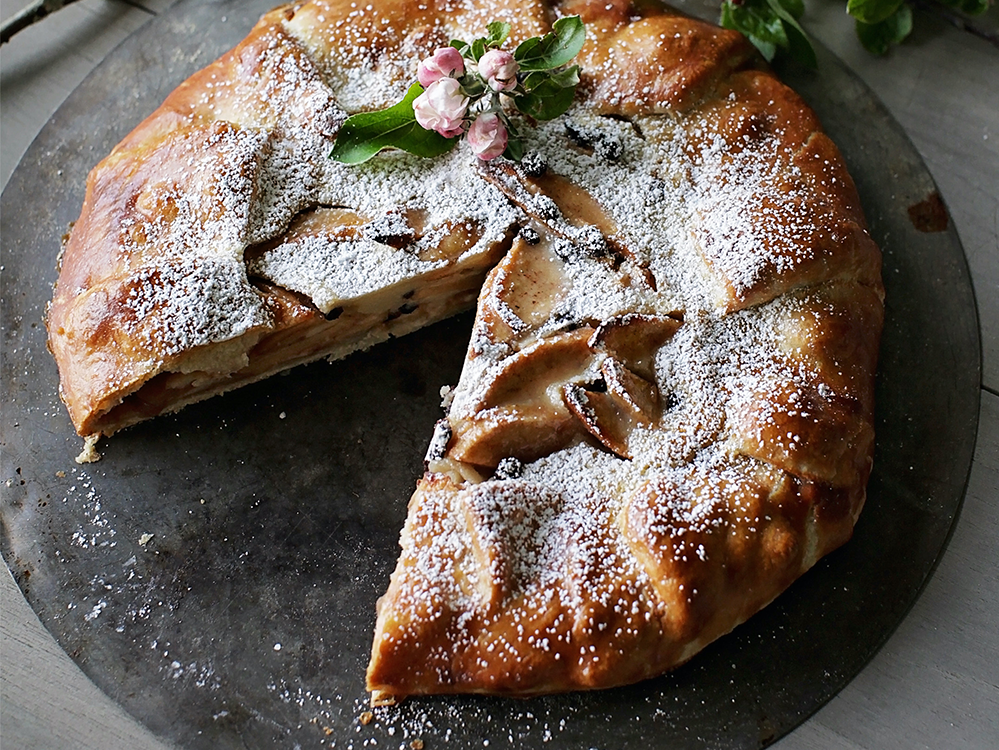
In 1996, I was surprised and honored to receive a call that Julia Child was interested in featuring me in an episode of Baking with Julia, a show that would later go on to win an Emmy Award and a James Beard Award. I flew out to Boston and made this lovely Normandy Apple Tart in the kitchen of Julia Child’s imposing Cambridge clapboard house. This tart is a free-form variation of what I made for the show. It’s chock-full of sliced apples, brandied currants, and topped with a creamy custard that you add in the final 20 minutes of baking.
1 disk Macrina Flaky Pie Dough, thawed but chilled
3 Granny Smith apples
3/4 cup granulated sugar, divided
1/2 tsp ground cinnamon
2 eggs, divided
1/4 cup unbleached all-purpose flour
2 Tbsp powdered sugar
Line a rimmed baking sheet pan with parchment paper. Set aside.
In a small bowl, soak the currants in 2 Tbsp of brandy for 10 minutes.
On a floured work surface, roll out the pie dough to a 14-inch x 1/8-inch circle. Trim any excess. Gently fold the dough in half and lift it onto the prepared baking sheet. Unfold the dough and center it on the sheet pan. Some dough will cascade over the edge of the pan.
Peel and core the apples. Cut the apples into 1/4-inch slices and place them in a medium bowl. Add 1/2 cup sugar, cinnamon and the brandied currants. Toss to evenly coat the apples.
Place the apple mixture in the center of the rolled pastry dough. Spread it out to create a 10-inch mound.
Make an egg wash by thoroughly mixing 1 egg and 1 Tbsp of water in a small bowl.
Begin folding the uncovered dough (approximately a 2-inch rim) onto the apples to create a free-form tart. As you make each fold, brush the top with the egg wash to seal any overlap. When you’ve finished folding over the excess dough, give the top dough another brush of egg wash for even baking.
Refrigerate the formed tart for 30 minutes.
Preheat your oven to 400°F.
In a food processor, add the remaining 2 Tbsp brandy, 1/4 cup sugar, egg and flour. Mix for 1 to 2 minutes to combine well. Pour the custard into a smaller container to add to the tart later.
Bake the chilled tart for 25 minutes or until you see the crust and apples beginning to color. Remove the tart from the oven and pour as much custard as possible over the apples in the center of the tart. Use a knife or spatula to gently nudge the apples to let the custard settle.
Return the tart to the oven and bake for another 20 to 25 minutes, until the custard is set.
Let cool for 30 minutes. Sprinkle with powdered sugar and serve warm. Enjoy!To make the streusel, melt the butter in a saucepan over medium heat. Remove from heat, then whisk in brown sugar, granulated sugar, cinnamon, salt, flour, and vanilla until evenly combined. Scrape into a small bowl and let cool.
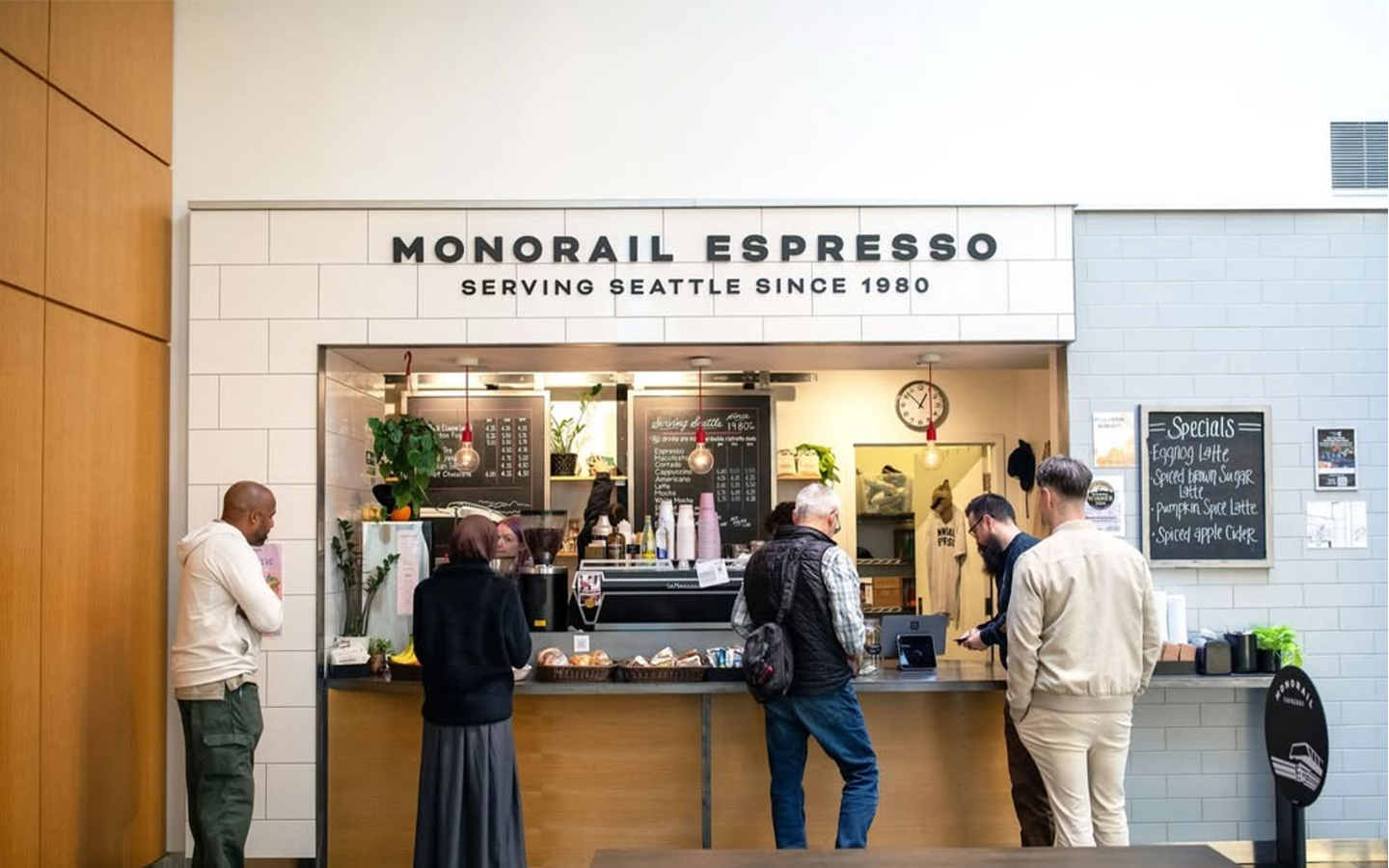
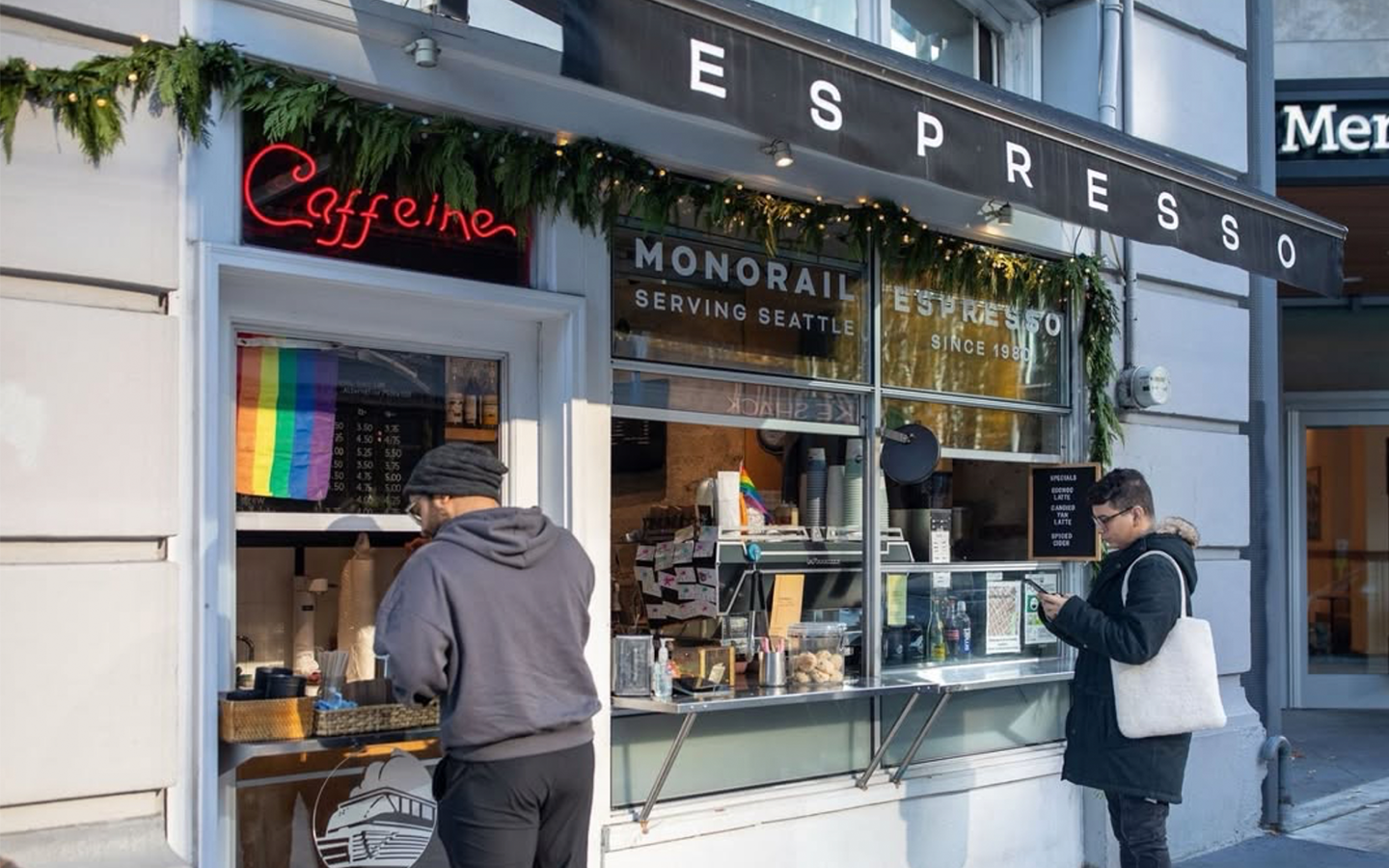
What is it about a coffee ritual that makes it so central to a good day? First, there’s the coffee: freshly roasted premium beans blended just right. Then there’s the preparation, a skill that can take months to master. And as important as anything: standout customer service. This is the essence of Monorail Espresso.
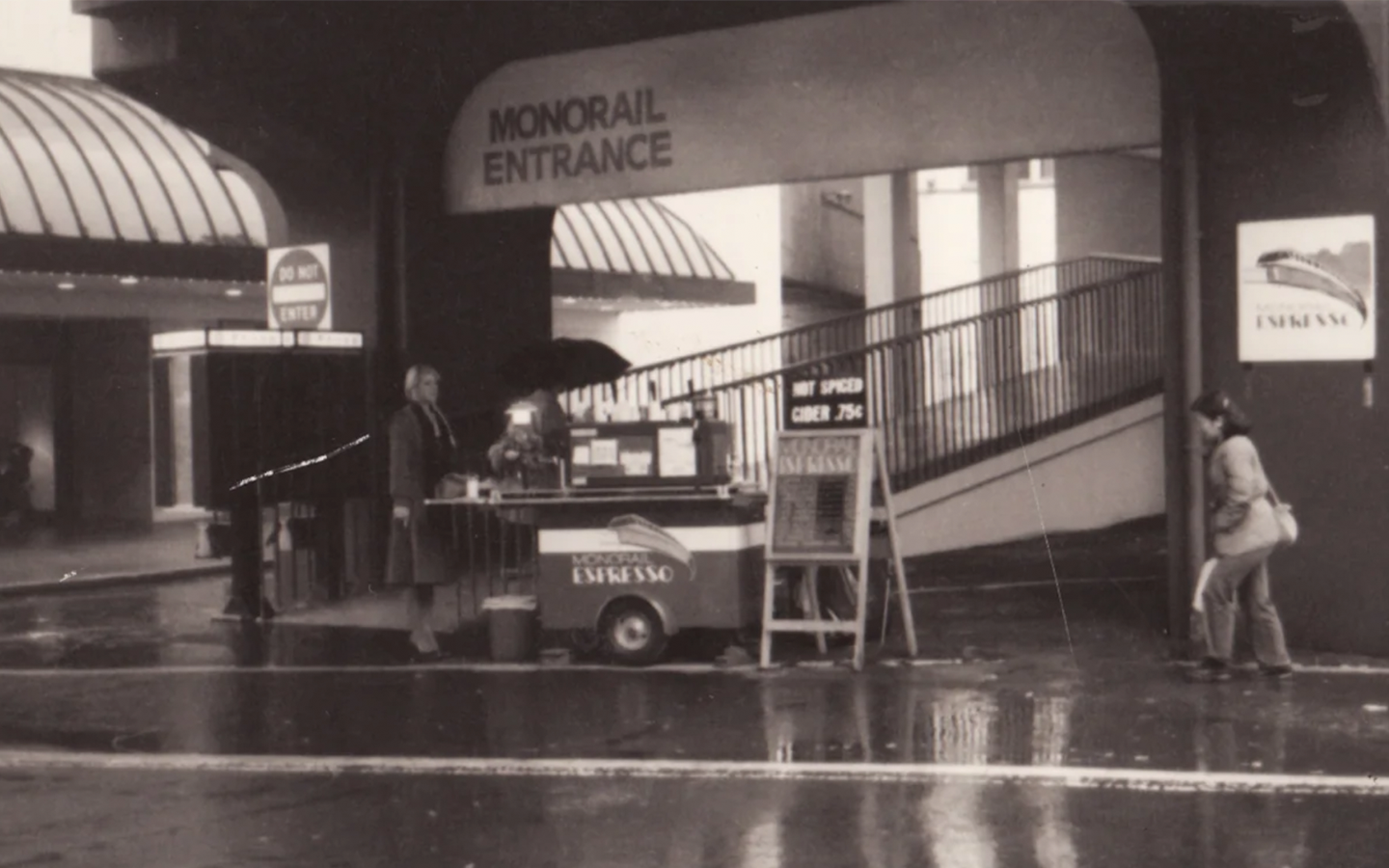
The espresso cart is now ubiquitous across America, but it started here, in Seattle, with Monorail Espresso. On December 1, 1980, Chuck and Susie Beek began serving espresso from a cart under Seattle’s Monorail, two years before Howard Schultz joined Starbucks. The cart itself was built by Kent Bakke and John Blackwell of La Marzocco, a pioneer in bringing high-quality espresso machines to America. They wanted espresso in the street, modeled on the quick espresso kiosks at Italian train stations. They bought a utility cart from the Boeing surplus yard, rebuilt it to hold an espresso machine, and created what would become the original espresso cart for Monorail Espresso. Early commuters lined up for strong, ristretto-style coffee, and the cart’s speed, quality, and personality sparked a downtown phenomenon. By the mid-‘90s, espresso carts were everywhere, following the path Monorail created.
Unlike many firsts, Monorail has continued to build on what it started, nurturing its reputation for serving the city’s best coffee. As downtown changed, Monorail adapted. Rising permit costs and shifting construction patterns pushed the cart from one spot to another. In June of 1995, Monorail converted from cart to the present walk-up window on Pike, a format central to its identity: direct, fast, friendly, and unmistakably urban.
After 32 years at the helm, Chuck Beek handed Monorail to someone who already knew the rhythm of the window — Aimee Peck, who joined the team in 2008 as a barista, rose into management, and bought the business in 2012. Under Aimee, Monorail has grown to a handful of downtown sidewalk cafés that echo the original: small, streetwise, and built for speed and skill — Columbia Center (2015), Westlake in the Denny Triangle (2018), 4th Avenue (2022), and most recently, Pine Street inside the Seattle Convention Center Summit building.
“There are a lot of new people in Seattle,” Aimee says, and her mission has been to keep a landmark alive as the city changes. “We are kind of very iconic… my mission this entire time is to just keep this iconic business alive.”
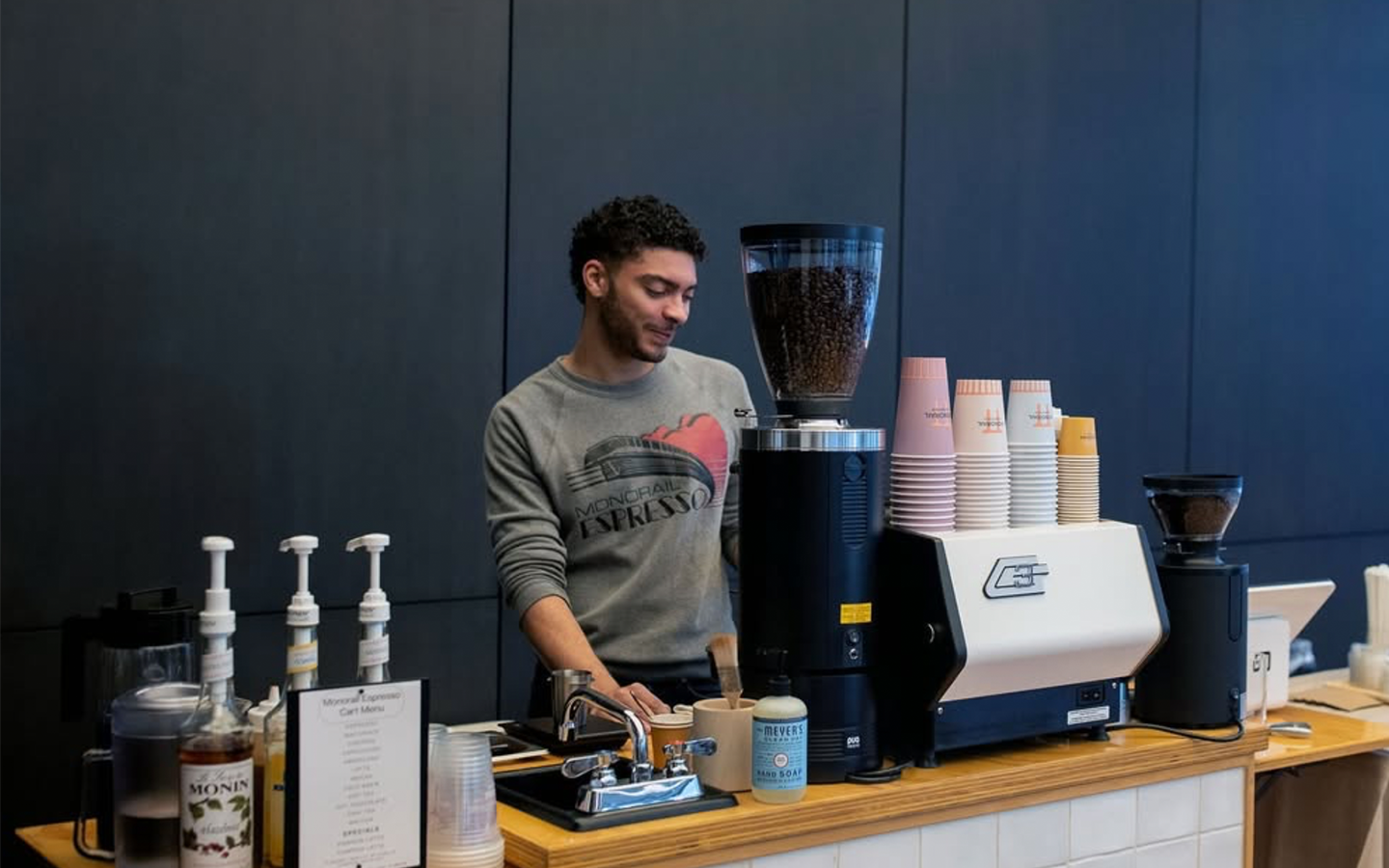
Monorail roasts its own coffee and has used the same espresso blend since the late ‘80s. “We don’t follow fads,” Aimee says. The shops are intentionally small — walk-up windows built for speed and focus — so Monorail keeps the menu tight and the standards high.
The coffee is only half the equation. “Obviously, the coffee is really good,” Aimee says, “but how the baristas prepare it is essential. You can take a beautiful coffee and ruin it easily.” Training is rigorous, quality checks are constant, and the expectation is simple: “Our ethos is basically good quality espresso and great customer service.”
That same clarity shows up in Monorail’s culture. Employee tenure is extraordinary. Investing in the team is part of the ethic: manager retreats have included trips to the La Marzocco factory in Italy and visits to the Costa Rican farms that supply some of its coffee beans.
And while coffee is the center of gravity, the experience extends beyond the cup. For years, Monorail has paired its espresso with Macrina baked goods, a partnership Aimee describes in the same terms she uses for Monorail: dependable and uncompromising. “We love Macrina products,” she says. “The quality is super consistent… and you guys show up every day, week in and week out.”
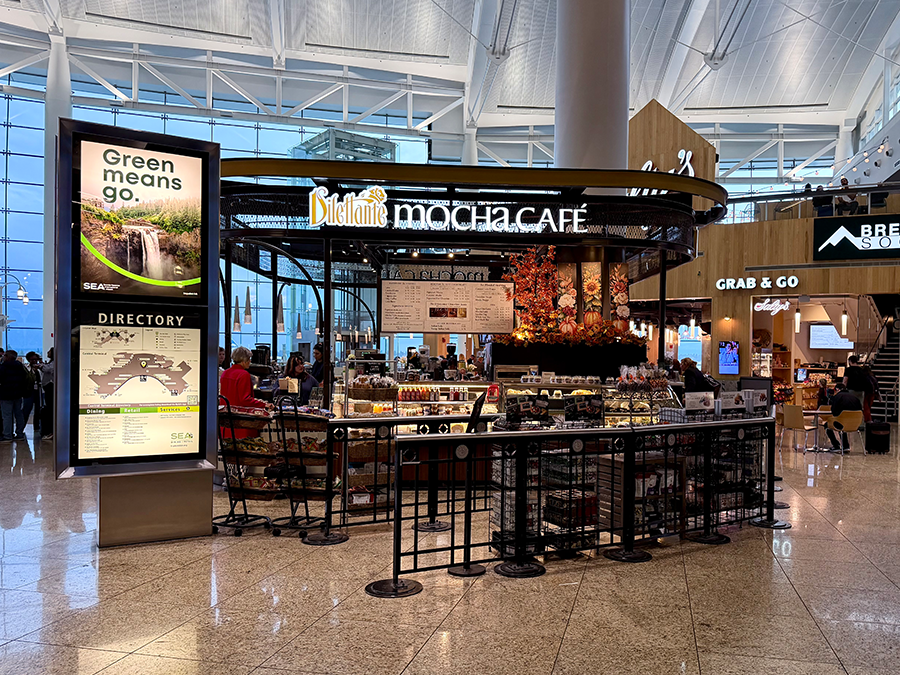
Inside Sea-Tac’s 24/7 Dilettante Mocha Café, where 1,500 daily customers, a choose-your-cocoa “Chocolate Scale,” and a veteran crew keep the Central Terminal buzzing.
By 4 a.m., the Dilettante Mocha Café in Sea-Tac’s Central Terminal is already humming. The line moves briskly as red-eye travelers and airport staff grab a quick breakfast and a caffeine boost. Steam wands hiss, and the morning crew of eight sees to it that their signature chocolate-forward mochas, all manner of coffee-based drinks, breakfast sandwiches and pastries come out quickly. If you’re racing the clock, there are grab-and-go items including hot-case breakfast sandwiches, Macrina pastries, and drip or cold brew at the register.
With renovations in 2019 and 2023 complete, the Central Terminal has become the airport’s beating heart. In 2024, a record 52 million passengers traveled through Sea-Tac, the bulk of them passing through the bright, soaring space. Dilettante’s Mocha Café is situated in the middle of it all, open 24 hours, seven days a week, an oasis for those seeking sustenance and gift boxes of chocolates and other indulgent treats.
Debra Tyner, the general manager who oversees the cafés, has been with Dilettante for ten years. The Central Terminal is her home base. “It’s a 24-hour café, so I’m pretty much on call all the time,” she says. Good, experienced baristas are key to the café’s success, from quality to customer experience. Many baristas have been working at the café for years. In fact, Debra’s first hire is still there nine years later.
Founded in 1976 by third-generation chocolatier Dana Davenport, and rooted in family craft that reaches back to 1898, the original Capitol Hill “The Dilettante” evolved from a chocolatier and late-night dessert temple into today’s Mocha Café. Debra says, “Chocolate is still at the heart of what we do. The Mocha Café combines both: our chocolate heritage and coffee culture. When you walk through the airport, we’re the only café offering a chocolate scale where you can choose your mocha’s flavor intensity. We offer a range, from white to milk to dark, plus our signature Ephemere chocolate and an extra-dark option. You’re not just ordering a mocha, you’re designing it around your preferred richness or sweetness.” Alongside the drinks, travelers pick up boxed truffles—salted caramels, raspberry and espresso truffles, nut clusters, toasted-coconut haystacks. Dark chocolate mousse cups are the top-selling dessert.
Macrina drops off fresh-from-the-oven pastries and cookies at 3 a.m., just before the rush. By 10 or 11, they’re usually gone. Beyond coffee—drip, cold brew, lattes, cappuccinos, and the famous mochas—you’ll find breakfast sandwiches and burritos, bagels, and a small lunch menu of turkey, ham, or chicken salad sandwiches. Simple salads (Caesar or arugula-pear), deviled eggs, snack packs, and cold-pressed juices round things out. For dessert, the case tempts with Midnight Mousse Cake, carrot cake, brownies, macaroons, and more Macrina cookies.
On a recent visit, the line moved quickly. Guests in a hurry were steered to drip coffee and grab-and-go items. Those after something more personal waited a moment longer for custom drinks. Despite the volume, the drinks arrived quickly, with the sort of velvety foam that only comes from the hand of an experienced barista.
Busiest in the state? There’s no centralized database, but it seems plausible: a café in the center of Sea-Tac’s Central Terminal, open around the clock, serving a community that never really sleeps. People stream past with carry-ons, pausing for something warm and good before the next gate call. As Debra said, “You’d be surprised how many people order coffee at two in the morning.”
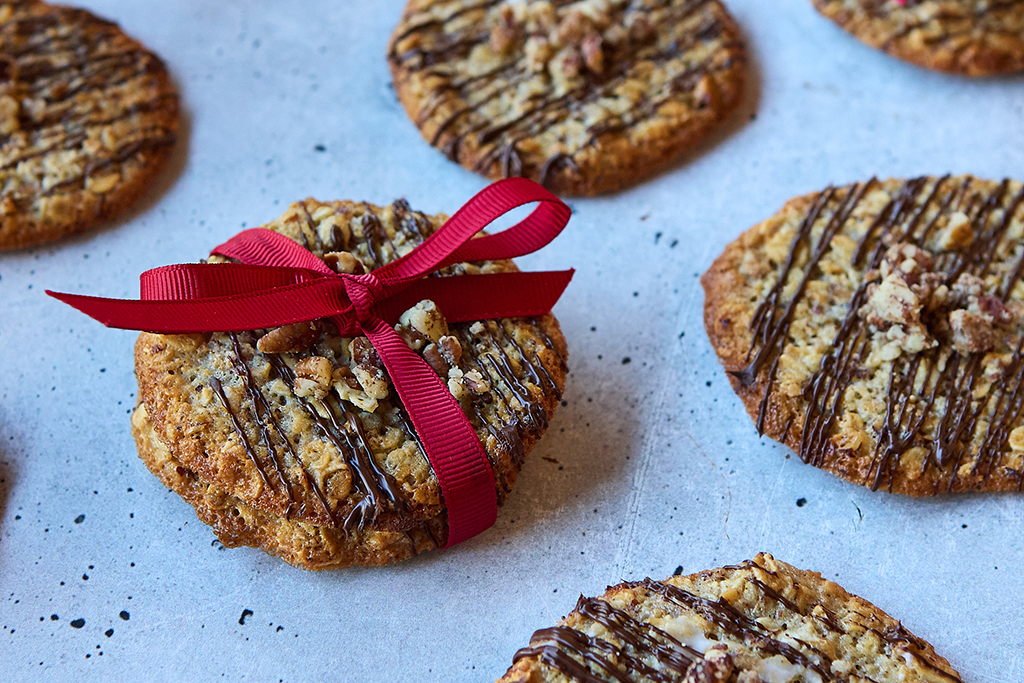
A delicate, traditional Scandinavian cookie made with oats, rye flakes, and a drizzle of bittersweet chocolate. I plan to make these part of my Valentine’s Day gift-giving treats! For the best texture, toast the pecans until fragrant, then cool completely before grinding so they stay nutty, not oily. I make them gluten-free — though you wouldn’t know it unless I told you — but you can make them with regular flour if you’d like. You might consider doubling the recipe, as they’ll disappear fast.
2 Tbsp gluten-free flour mix (we recommend Bob’s Red Mill GF 1-to-1); or sub all-purpose flour
1 cup rolled oats
3 Tbsp rye flakes
1 tsp baking powder
1/3 cup pecans, toasted and finely ground (walnuts are great also)
1/3 tsp kosher salt
3 1/2 Tbsp unsalted butter, melted
1/2 tsp vanilla extract
1/4 cup bittersweet chocolate chips
In a stand mixer fitted with the whisk attachment, beat the sugar and eggs at medium speed for 3 to 5 minutes, until light and fluffy in texture.
In a small bowl, combine the flour, oats, rye flakes, baking powder, pecans, and salt.
With the mixer at low speed, gradually add the oat mixture. Add the melted butter and vanilla and mix thoroughly. Let the cookie dough sit at room temperature for 30 minutes.
Preheat oven to 375°F and line 3 rimmed baking sheets with parchment.
Using a tablespoon to portion the dough, drop 9 cookies per baking sheet. Flatten slightly to make a round or heart design. These cookies spread, so leave 1 to 2 inches between each cookie.
Bake for 5 to 8 minutes, or until lightly golden brown in the center and deeper brown at the edges, rotating the baking sheets a few times for even baking. Remove from the oven and transfer the cookies to a wire rack to cool.
Melt the chocolate chips in a water bath: Fill a medium saucepan with a few inches of water and set a small heatproof bowl over the top (the bowl should not touch the water). Using a spatula, melt the chips completely, then remove from the heat. Using a spoon, drizzle chocolate over the cookies and let cool to set.
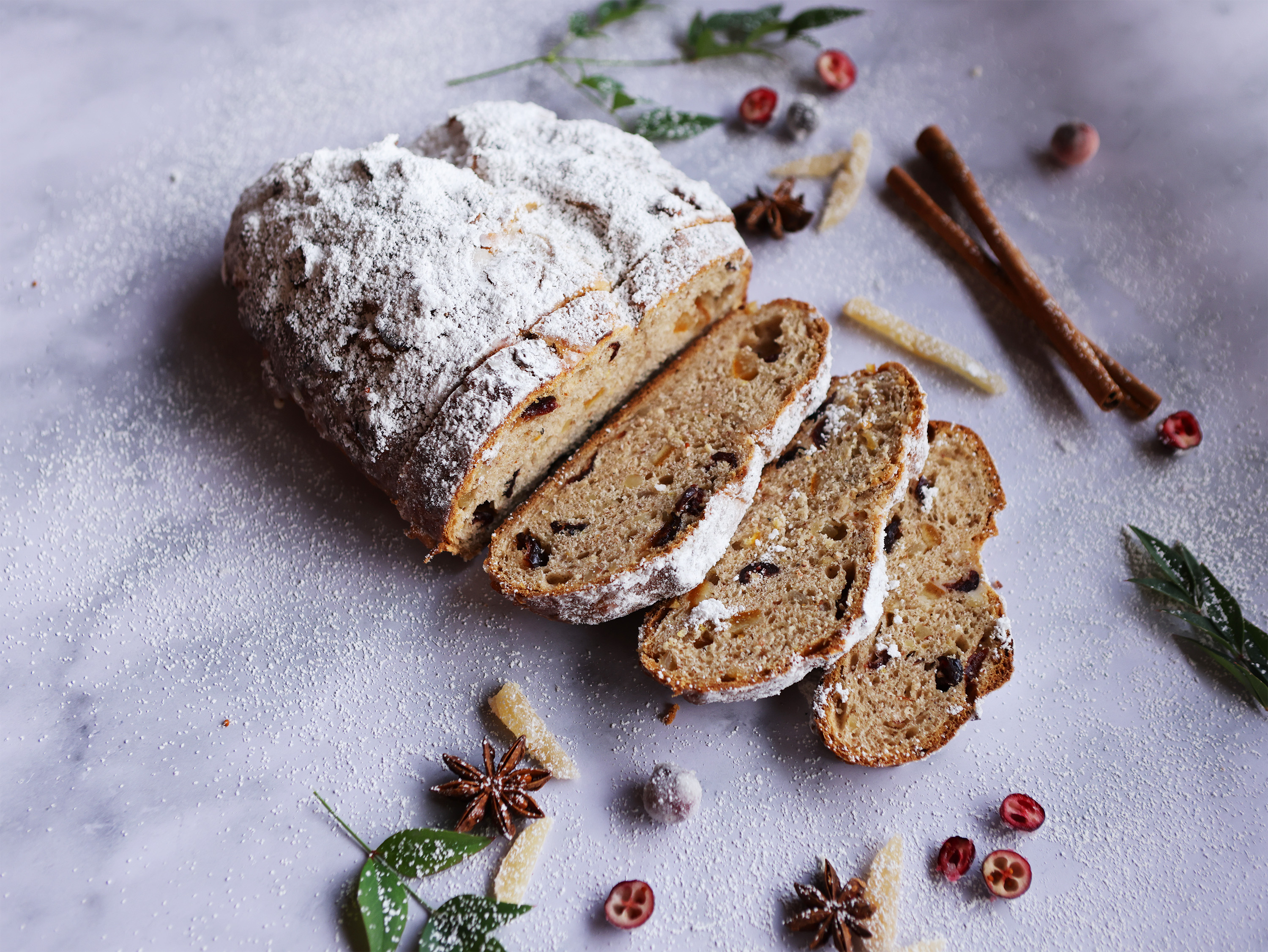
Holiday dried-fruit breads take many forms. I grew up with my mother baking her Norwegian family recipe, Julekake (YOO-leh-ka-ka). This holiday stollen keeps that spirit and takes inspiration from the traditional German holiday bread with its rich dough packed with raisins, cranberries, candied orange peel, and ginger, and holiday spices. Brushed with rum and butter, and with a tender crumb textured with ground almonds, the holiday stollen is excellent sliced and toasted. The smell of these baking takes me right back to my childhood and the aromas that kicked off the festive holiday season at my house.
In a medium bowl, combine the cranberries, raisins, candied ginger, orange peel, and 1/4 cup rum. Let marinate for 1 hour or overnight.
In a small bowl, combine the ground almonds and 1/4 cup milk. Let sit for 1 hour to allow the almonds to absorb the milk.
In the bowl of a stand mixer, combine the remaining 1/2 cup milk (lukewarm), yeast, and 1 Tbsp sugar. Fit the paddle attachment and mix for 1 minute, then let stand 2 minutes until slightly foamy.
In a medium bowl, combine the remaining 1/4 cup sugar, flour, cardamom, cinnamon, nutmeg, cloves, allspice, lemon zest, and salt. Sift together with your hands to combine. Set aside.
Add the egg, vanilla, and the almond mixture (do not drain) to the milk mixture. Mix for 1 minute to combine.
Add the flour mixture in three additions, mixing after each until incorporated. Lower the bowl, change the attachment to a dough hook, and mix about 3 minutes to bring the mixture together.
With the mixer on low, add 1 stick of the butter in dime-sized pieces, mixing until fully absorbed. Mix for another 5 minutes, until the dough is elastic and slightly shiny. Let rest 5 minutes. Add the marinated fruit. Mix about 2 minutes to distribute evenly.
Pull the dough out onto a lightly floured work surface. Form into a ball, place in a lightly oiled bowl, cover with plastic wrap, and let proof for 2 to 3 hours. The dough will increase in size and feel slightly spongy.
Again, pull the dough onto your slightly floured work surface, and press into a 10-inch square, and divide in half.
For each piece, bring the two shorter sides toward the center. Flatten the right side, then roll the left side into a log and lay it over the right side leaving a 1-inch border. Slightly flatten the rolled side.
Place both loaves on a parchment-lined baking sheet and cover loosely with plastic wrap to prevent them from drying out. Let rise at room temperature until slightly puffy, about 1 hour. Meanwhile, heat the oven to 325°F.
Bake on the center rack for 40 to 45 minutes, until deep golden brown.
Melt the remaining 1/2 stick of butter and stir in the remaining 2 Tbsp rum. Brush the butter mixture over the warm loaves to saturate the crust. Dust generously with powdered sugar. Allow to sit an hour, then dust a second time so that it keeps its white appearance.
Cool completely, then wrap in plastic. Stollen keeps well at room temperature for 2 to 3 weeks. Enjoy toasted slices with jam, butter or honey butter.
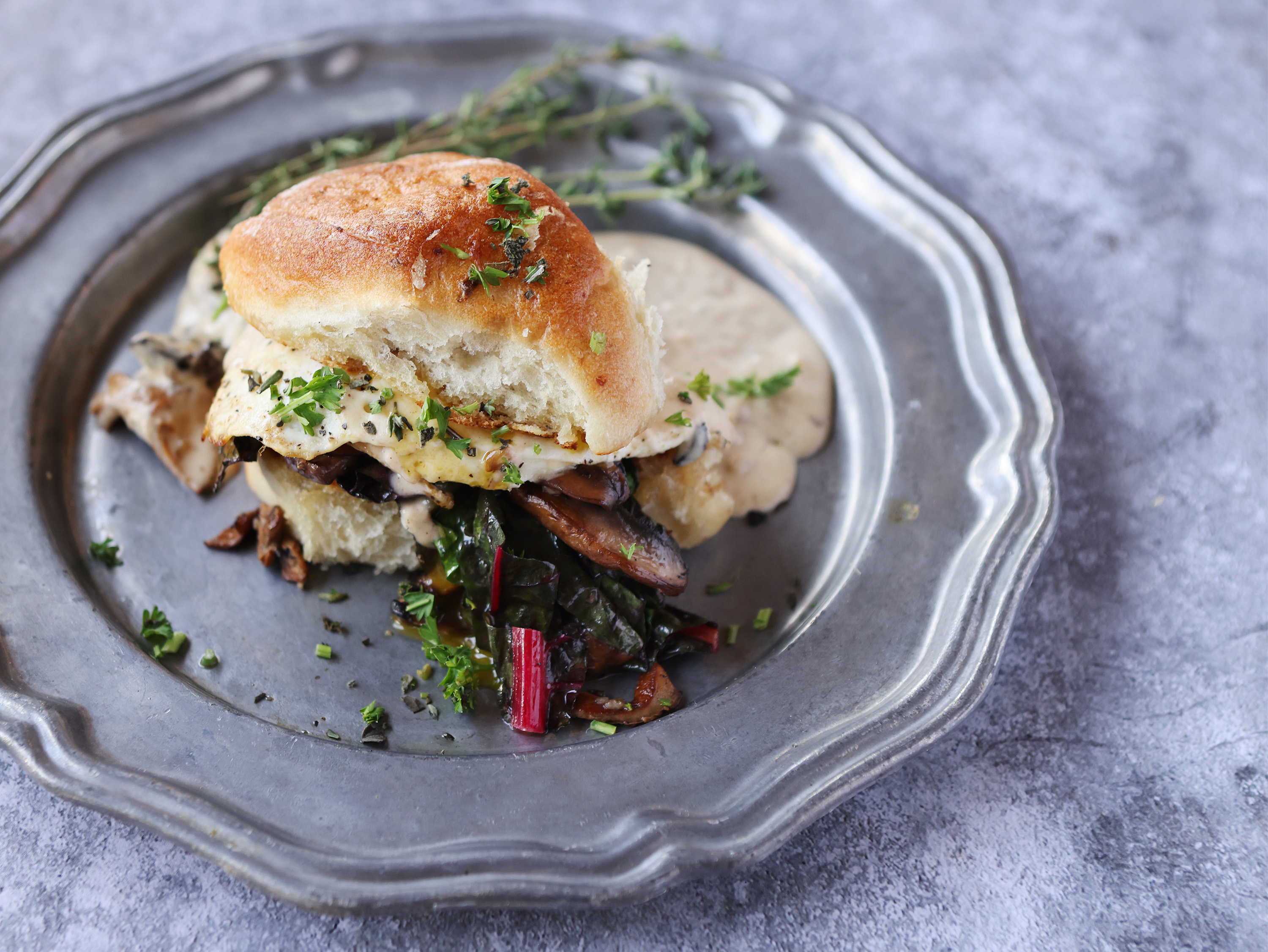
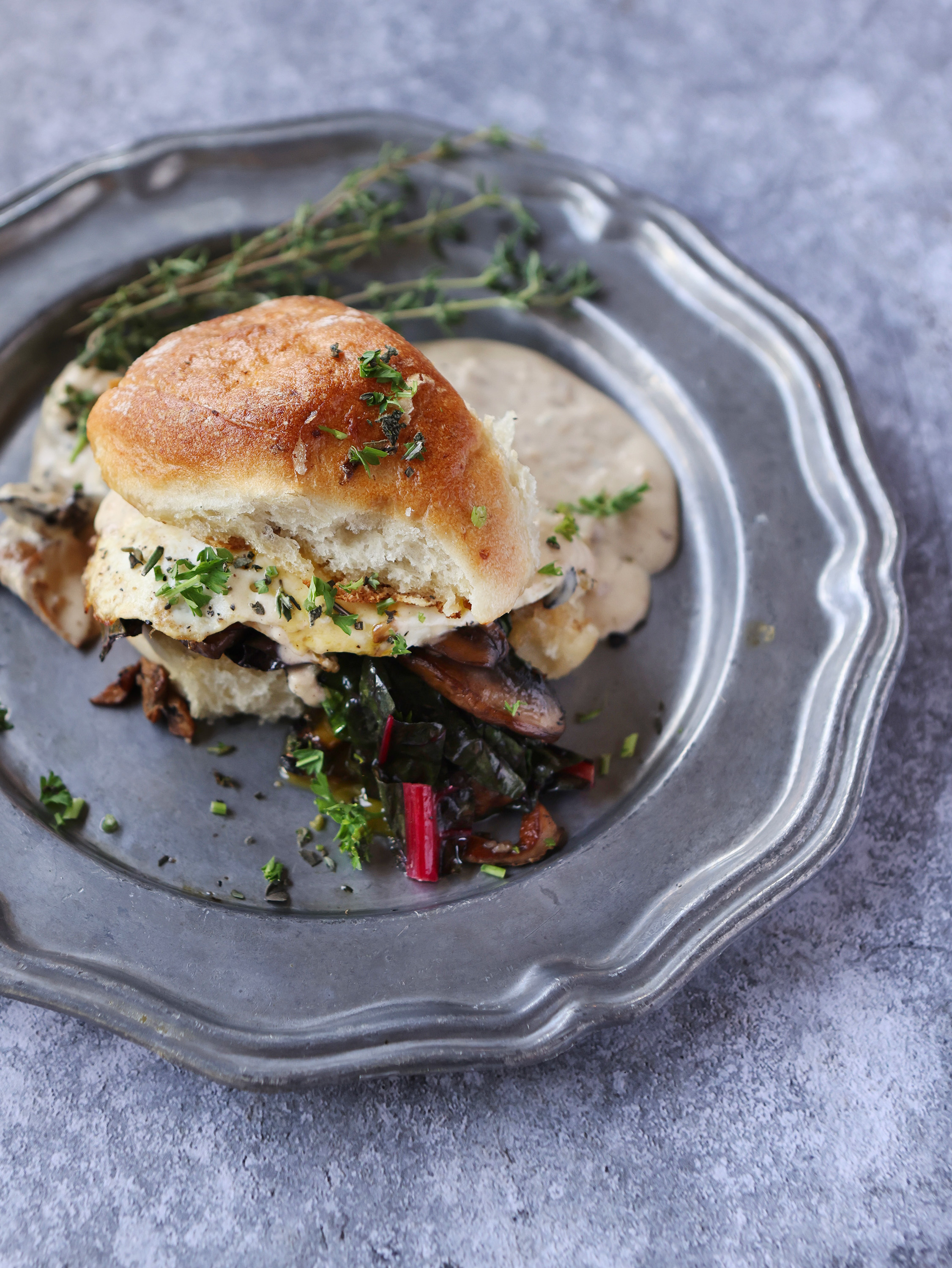
During this time of year, I usually have a Macrina Buttermilk Dinner Roll Tray on my counter. They’re so versatile. I spread them with butter and Project Barnstorm conserve jam, or fill them with turkey and avocado for a quick lunch. On quiet mornings, I turn them into a breakfast sandwich that makes any day feel special.
The tender rolls have a gentle tang, perfectly paired with savory mushrooms, garlicky rainbow chard, and an over-easy egg, all finished with a drizzle of mushroom-onion gravy. Each bite is rich, comforting, and full of contrast.
Serve it with coffee or tea and fresh fruit for breakfast, or a simple green salad or salted tomatoes and cucumbers for lunch. Either way, it’s a sandwich sure to brighten the day.
Trim and discard the mushroom stems, then brush off any debris from the caps and slice them into 1/4-inch pieces.
In a large sauté pan over medium-high heat, warm 1/4 cup olive oil. When the oil begins to sizzle, add the mushrooms and sauté for 2 to 3 minutes, stirring, to caramelize and intensify their flavor. Add 2 tsp garlic and 2 tsp thyme. Season with salt and pepper. Cook about 1 minute, until the garlic is golden. Transfer the mushrooms to a bowl to cool. After 10 minutes, coarsely chop half the mushrooms for the gravy. Reserve the rest for assembly.
In a medium saucepan over medium heat, melt 3 Tbsp butter. Add the onion and cook until translucent, about 2 minutes. Whisk in the nutmeg, allspice, and flour. Cook, whisking, until the roux is golden. Reduce the heat to low. Gradually whisk in the cold milk until smooth, then whisk in the cream. Simmer gently, whisking, until thickened to a pourable gravy. Whisk in the cheese until melted, then stir in the chopped mushrooms and season with salt and pepper to taste.Transfer to a bowl and keep warm over a water bath.
Preheat the oven to 325°F. Warm the roll tray for 8 to 10 minutes. Place 4 rolls on plates and split, setting the tops aside.
Set a sauté pan over medium-high heat and warm 2 Tbsp olive oil. Add the remaining 1 tsp garlic and 1 tsp thyme; cook about 30 seconds until fragrant. Add the rainbow chard, season with salt and pepper, and sauté for 1 to 2 minutes, until wilted. Add the reserved cooked mushrooms and cook 2 minutes to rewarm. Divide the mixture among the roll bottoms.
Set a clean sauté pan over medium heat. Add the remaining 2 Tbsp olive oil and 1 Tbsp butter. When the butter sizzles, crack in the eggs and season with salt and pepper. Cook over-easy, 2 to 3 minutes per side.
Top each roll bottom with an egg. Spoon on warm gravy, sprinkle with parsley, and cap with the roll tops. Serve with a knife and fork while hot.
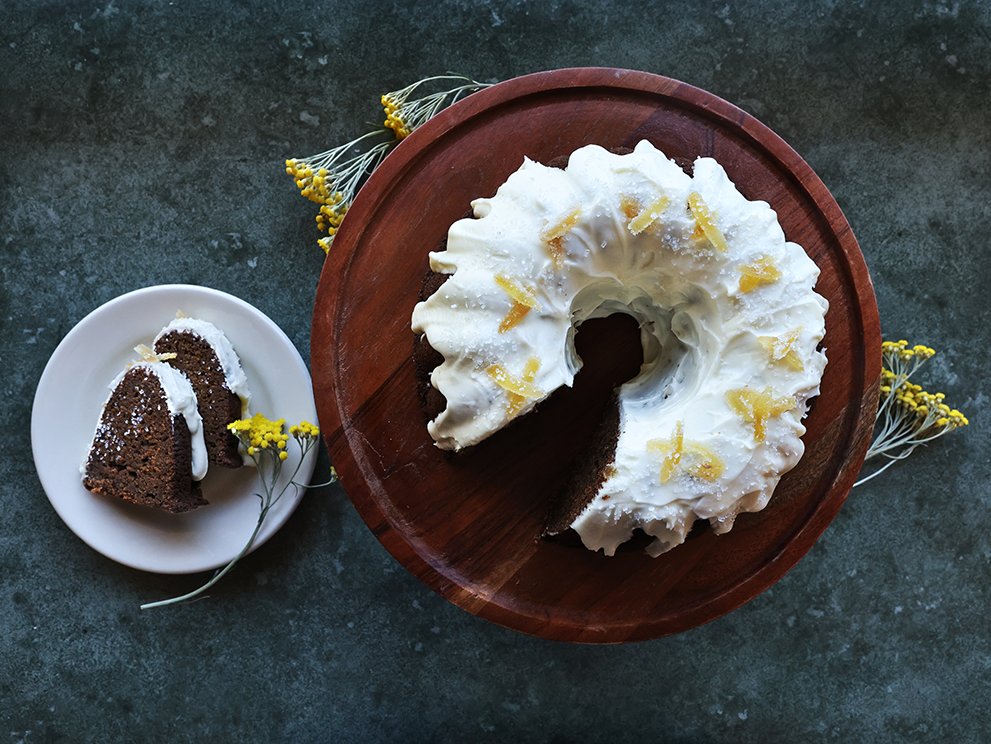
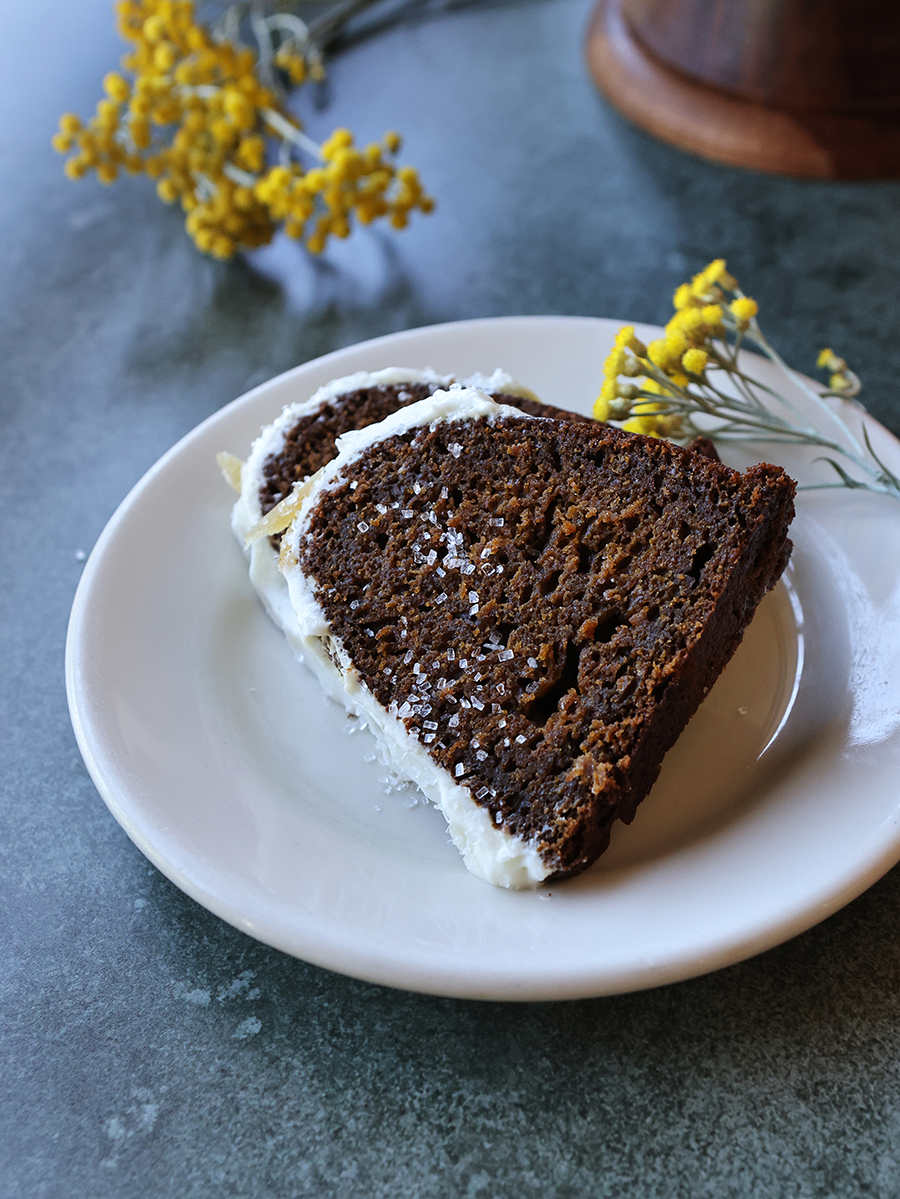
Every fall, we use this recipe to make our gingerbread cupcakes for the cafés. Even better, though, is the same thing in bundt cake form. It’s rich and deeply dark with blackstrap molasses, and the flavor of fresh ginger infuses the cake. The crumb stays tender thanks to buttermilk, and the cream cheese frosting accentuates the ridges of the cake. I made this in the classic Anniversary Bundt pan—about 11 inches across and nearly 5 inches deep, with graceful, sculpted ridges that give the cake a dramatic finish. Any Bundt pan of similar volume will work.
Preheat oven to 325°F. Brush the Bundt pan with oil and lightly dust with flour to prevent sticking.
In a medium bowl, sift together the flour, baking powder, baking soda, and salt. Set aside.
In the bowl of a stand mixer fitted with the paddle attachment, beat the butter, brown sugar, and ginger on medium speed for 3 to 4 minutes until light in texture.
Add eggs one at a time, beating well after each. If the mixture looks like it’s separating, add 1/4 cup of the flour mixture.
Blend in the molasses on medium speed, scraping the edges to ensure everything is thoroughly combined.
On low speed, add the remaining flour mixture and buttermilk in three alternating additions, doing the final mix by hand with a spatula.
Scoop the batter into the prepared pan, level the top, and set the pan on a rimmed baking sheet. Bake 30 to 35 minutes, until the cake is golden and a toothpick inserted in the center comes out clean.
Let cool for 30 minutes, then invert onto a serving plate.
CREAM CHEESE FROSTING
In a stand mixer fitted with the paddle attachment, whip the cream cheese and butter until smooth, about 2 minutes. Gradually add the powdered sugar, beating 2 minutes more. Thin with milk until the frosting just drips off a spoon.
Generously spoon the frosting over the cooled cake, letting it run down the sides. Decorate the cake with candied-ginger strips and crystal sugar.